Published displacement benchmark
Scordelis–Lo roof
A quarter cylindrical roof under distributed downward loading combines membrane and bending response. Results from three meshes of Quad4 · fully integrated assumed strain are compared with the published free-edge displacement reference.
Understand the analysis
A curved roof under distributed load.
A quarter cylindrical roof combines membrane and bending response. The comparison measures vertical displacement at the midpoint of the free edge on three shell meshes.
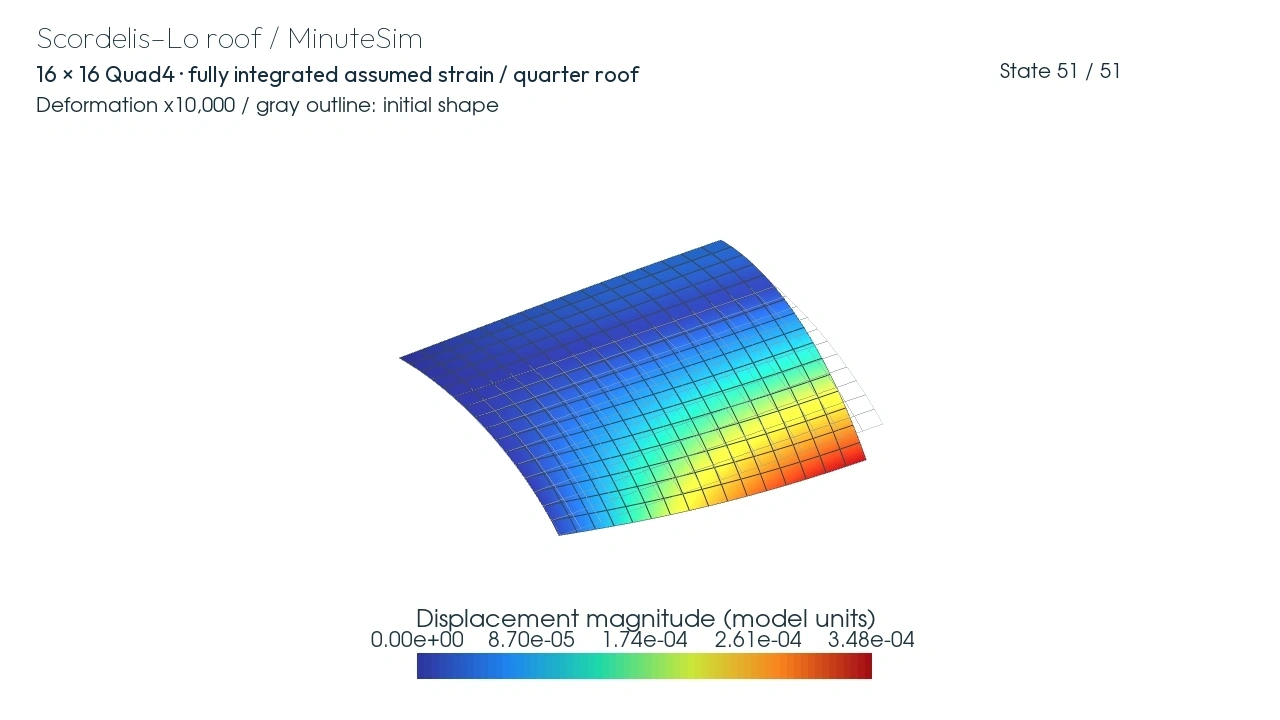
The 16 × 16 quarter-model mesh from the same result used in the table.
Full size ↗The saved loading and settling response, with deformation enlarged 10,000×.
Open video ↗Both views show only the computed quarter model, without symmetry duplication. Gray indicates the initial mesh. Deformation is enlarged 10,000×; the color legend shows the actual, unscaled displacement magnitude |u| in model units. This visual enlargement is separate from the 1,000× load normalization in the comparison table.
The normalized displacement is compared with the conventional published reference of 0.3024. The three results differ by +4.76%, +0.96% and +1.64%; the sequence is not monotonic.
Displacement across three meshes.
Download plotted data ↓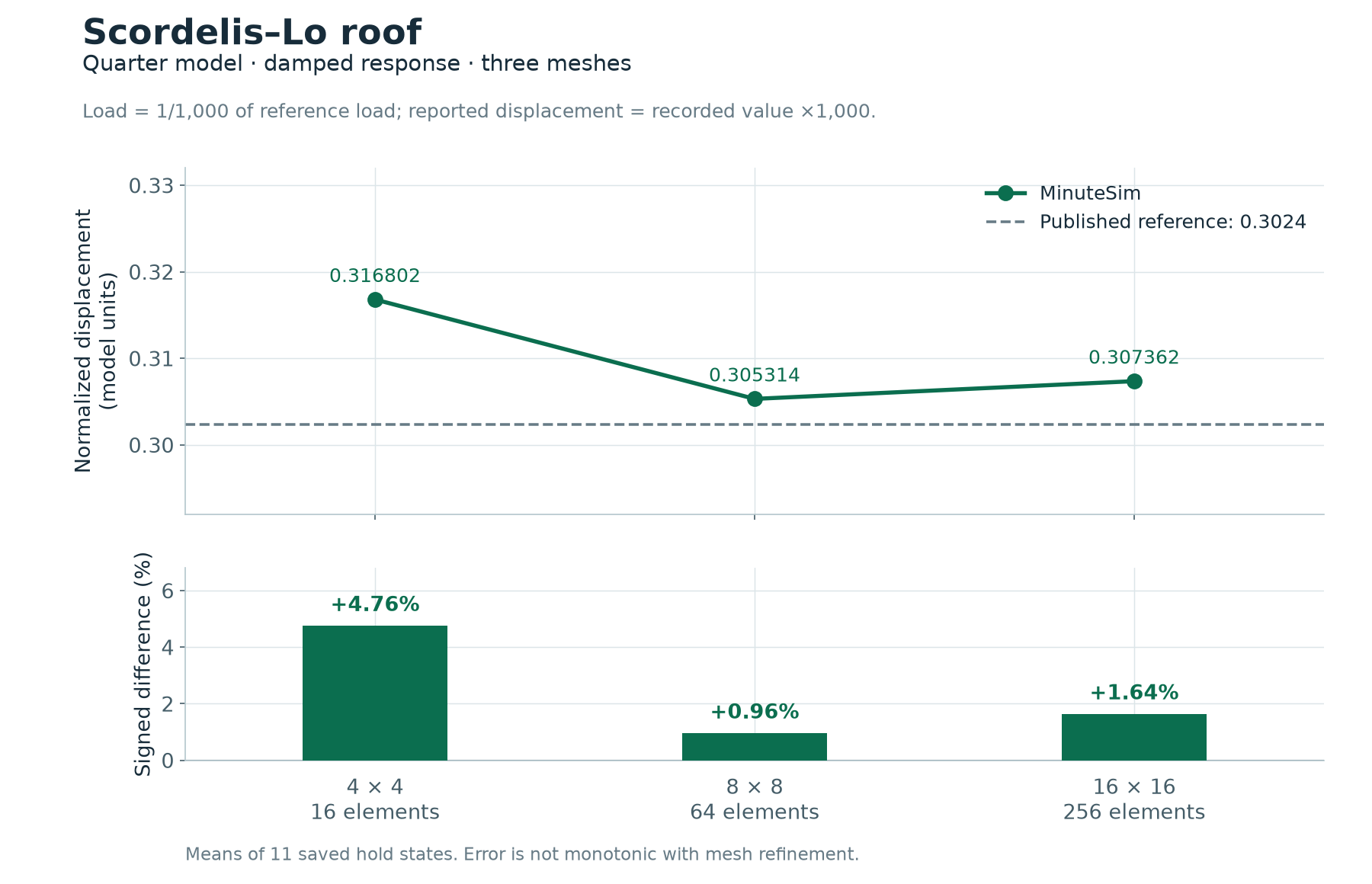
Mesh comparison
The applied downward load is 0.09 per unit area, or 1/1,000 of the conventional reference load of 90. To compare in the small-displacement range, the recorded displacement is multiplied by 1,000. This is a scaled-load comparison, not a direct full-load run. The table uses the mean of 11 saved settled-response states at model times 0.008–0.010.
Swipe sideways to read the full table →
| Quarter mesh | Elements | Nodes | Normalized displacement | Signed difference |
|---|---|---|---|---|
| 4 × 4 | 16 | 25 | 0.31680 | +4.76% |
| 8 × 8 | 64 | 81 | 0.30531 | +0.96% |
| 16 × 16 | 256 | 289 | 0.30736 | +1.64% |
Displacements use model units. Signed difference is 100 × (normalized displacement / 0.3024 − 1). The 16 × 16 result has a larger difference than the 8 × 8 result, so these data do not demonstrate monotonic mesh convergence.
Model and comparison conditions
Geometry and material
Roof radius: 25. Full length: 50. Thickness: 0.25. Half-angle: 40°. The consistent model-unit system uses E = 4.32 × 10⁸, ν = 0 and density 10−6. The quarter model uses Quad4 · fully integrated assumed strain with two through-thickness integration points and translational and rotational symmetry conditions.
Loading and readout
The distributed load reaches its plateau at model time 0.004 and is held to 0.010. Translational mass damping is applied with coefficient 9,000; rotational damping is off. The comparison uses the magnitude of the midpoint free-edge vertical displacement, after the stated load normalization. All three runs use an NVIDIA GeForce RTX 4060.
Reference and scope
The conventional displacement reference is 0.3024. NASA-CR-192816, printed page 18 and Figure 5, identifies this as the reference used by MacNeal–Harder. The Kratos Scordelis–Lo roof example describes the conventional benchmark geometry, loading and displacement measure.
Validation here is limited to the selected displacement for these three disclosed scaled-load, damped configurations and the conventional reference. It does not establish a universal shell-error bound or validate local stress fields, arbitrary loads or all shell configurations.
Evaluation results: 8 October 2026. Values are not a claim about every released solver version.
VALIDATED · Selected displacement comparison for the three stated scaled-load configurations and conventional reference. Evidence and comparison scope ↗