Beam theory + Solver B
Three-point bending
Compare MinuteSim and Solver B under three-point contact bending, with beam-theory markers at three punch displacements.
Understand the analysis
A punch bends the beam between two supports.
The centre punch pushes down while the two outer supports carry the beam. Solid and shell versions show how the element choice affects deformation and the measured punch force.
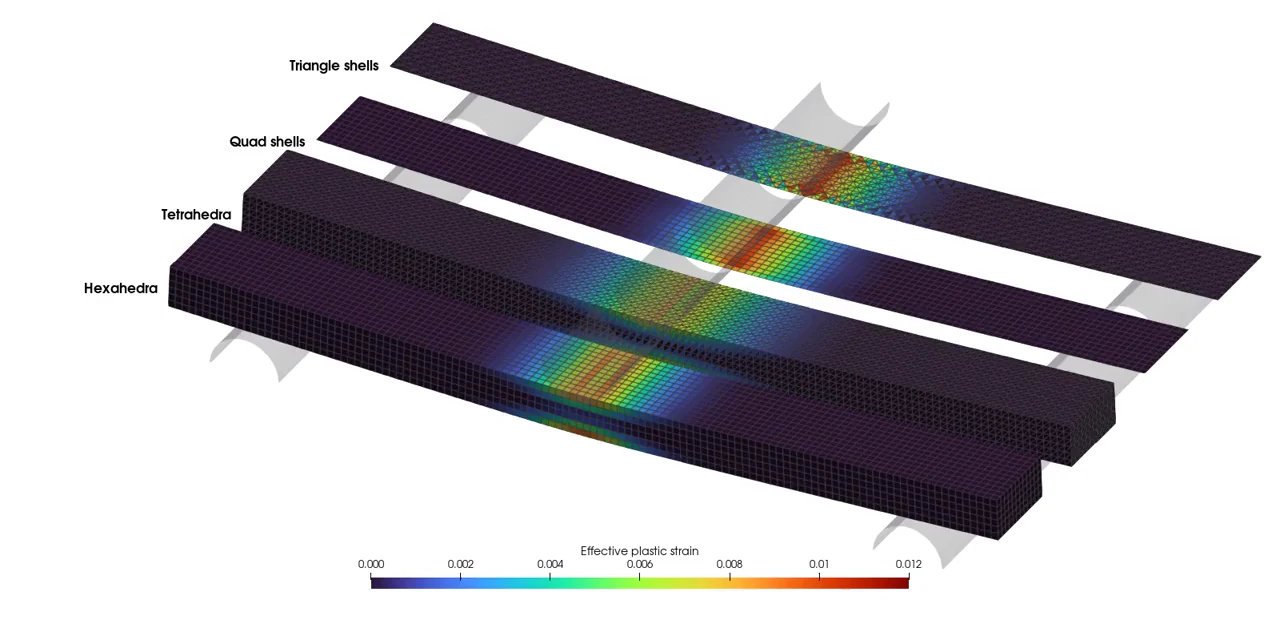
Four element families under three-point contact bending.
Full size ↗The punch moves down and plastic deformation develops near mid-span.
Open video ↗Separate output run of the contact model; the tetrahedral lane uses the one-point variant. Colour shows effective plastic strain. Deformation is shown at its actual scale.
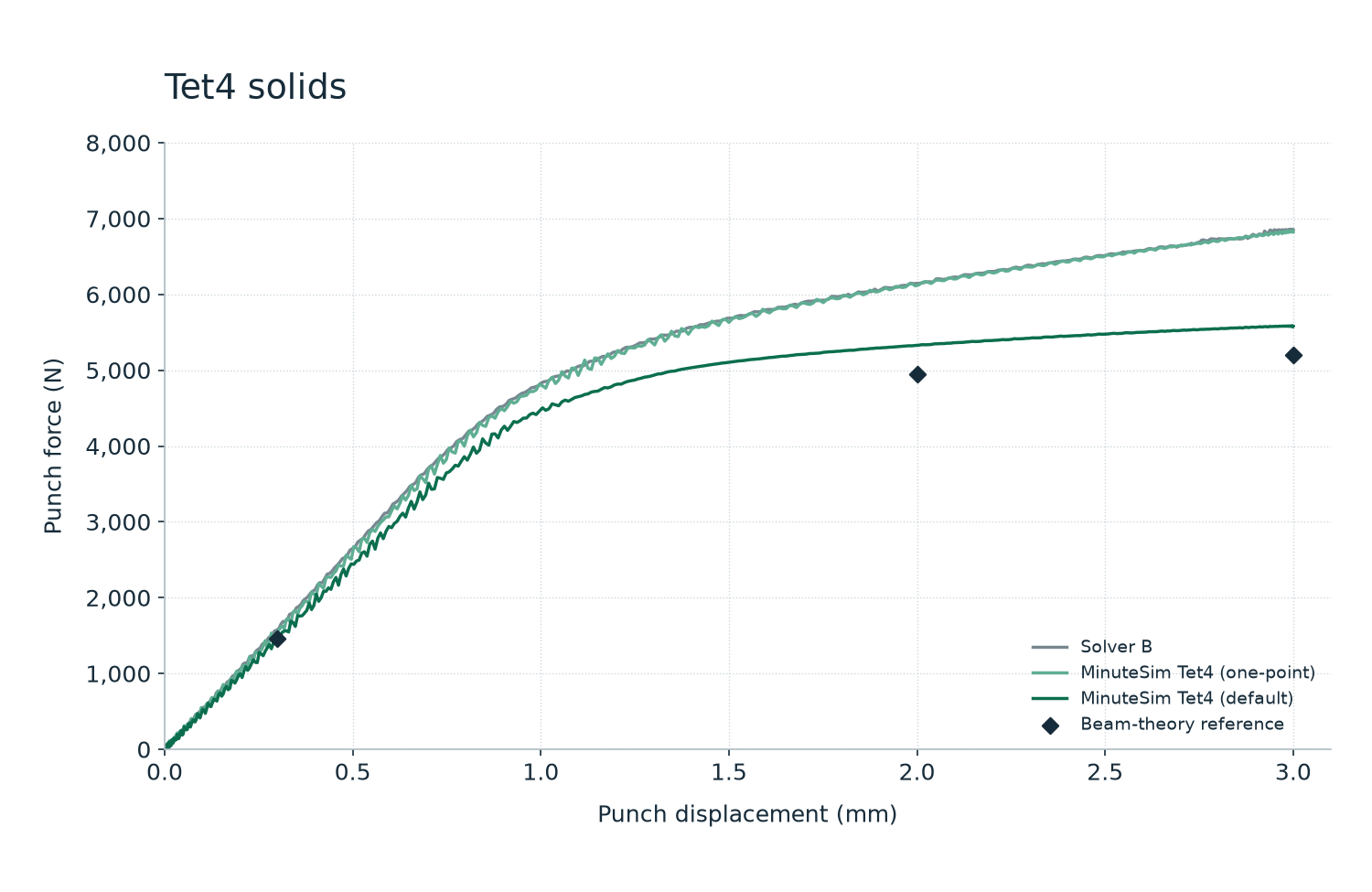
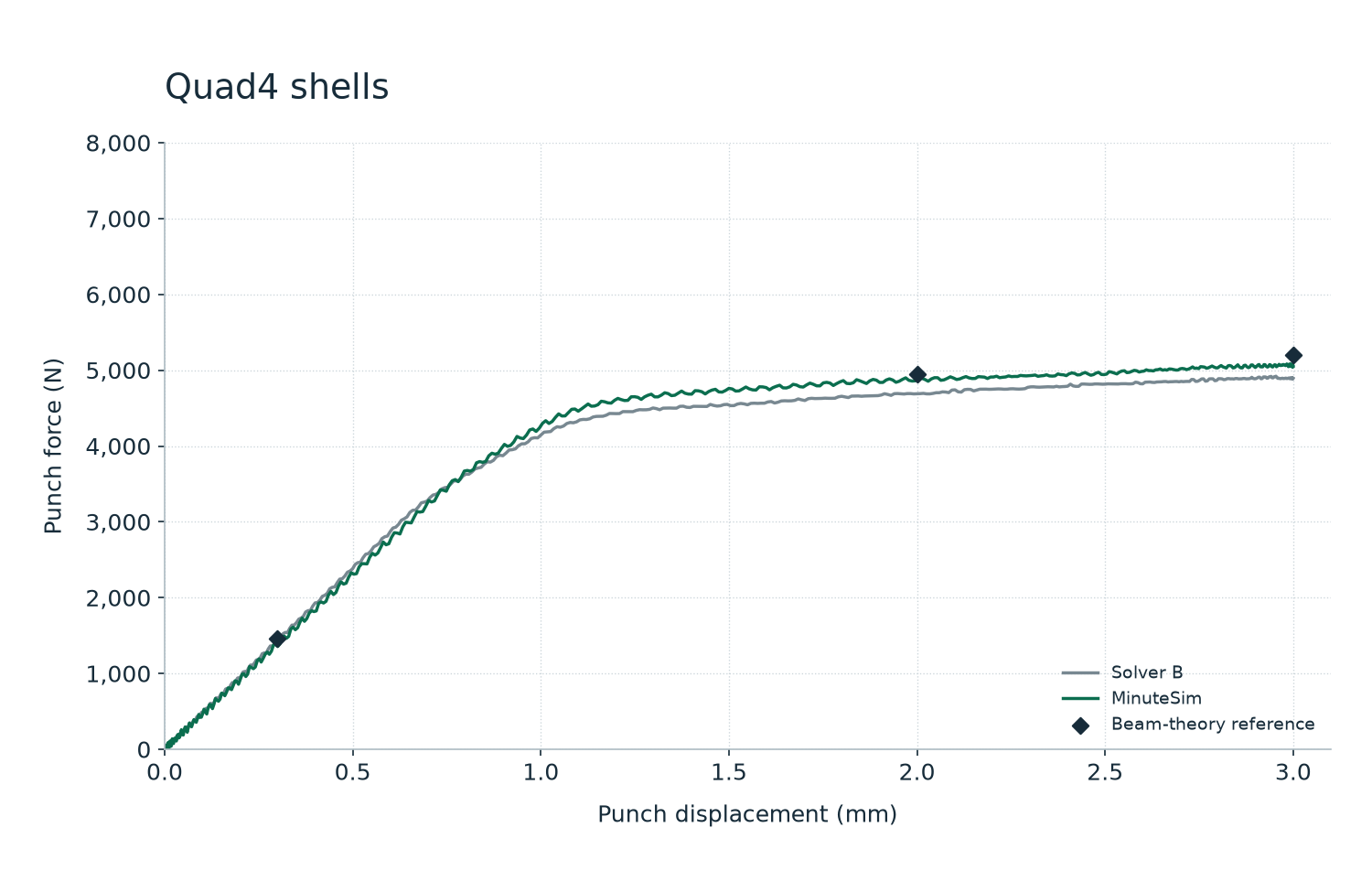
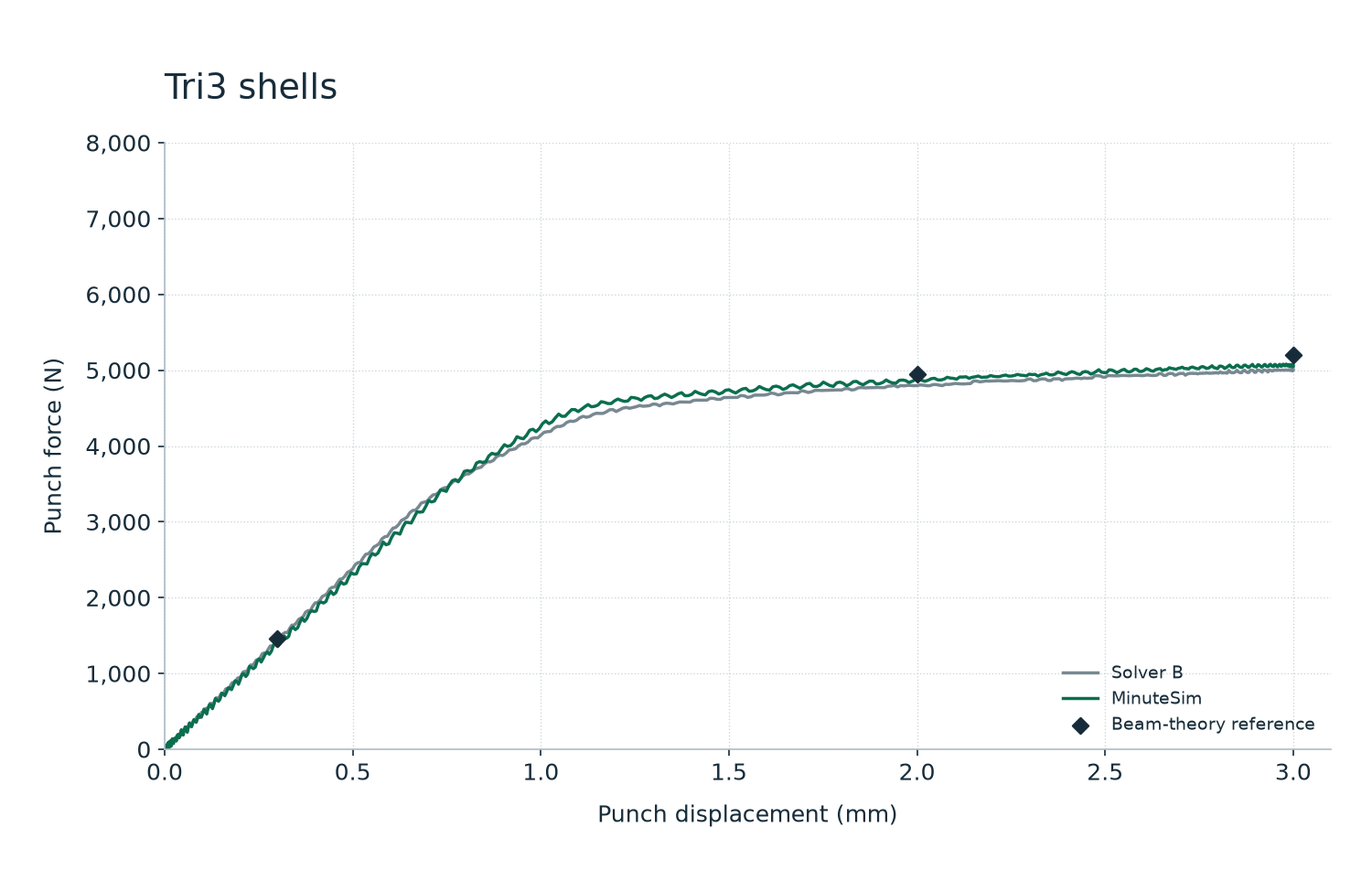
At the 5,197.0 N beam-theory reference, Hex8 differs by +2.2% and both shell cases by −2.6%. The default Tet4 is +7.4%; the one-point Tet4 is +31.4%. The latter tracks Solver B’s one-point tetrahedron, whose difference is +31.8%.
Follow the force–displacement response.
Download plotted data ↓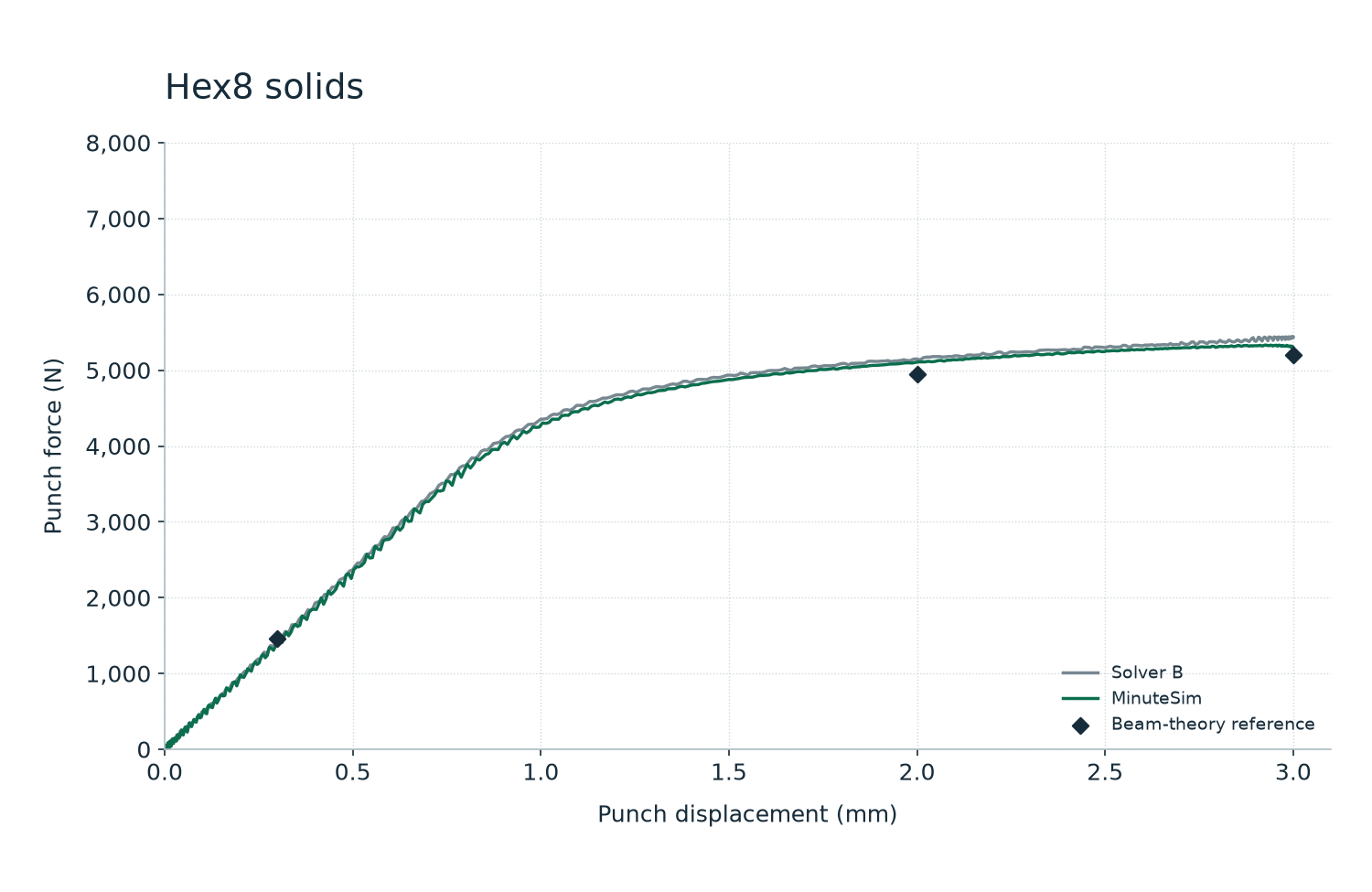
End-load comparison
The reference load is 5,197.0 N. MinuteSim end loads average 25 samples over 38.000–39.920 ms. Solver B uses the corresponding final 25-interval impulse-based window.
| Element | MinuteSim / N | Solver B / N | MinuteSim vs theory |
|---|---|---|---|
| Hex8 | 5,310.8 | 5,431.5 | +2.2% |
| Tet4 · one-point | 6,828.5 | 6,849.7 | +31.4% |
| Tet4 · default | 5,580.3 | — | +7.4% |
| Quad4 | 5,062.7 | 4,892.65 | −2.6% |
| Tri3 | 5,062.7 | 5,001.4 | −2.6% |
No corresponding Solver B result is shown for MinuteSim’s default Tet4 variant.
How to read this comparison
Reference and output
Black diamonds are beam-theory values at 0.30, 2.0 and 3.0 mm. Beam theory uses a load-line idealization; the contact model also includes local indentation. It is not an exact solution for every contact effect.
Force histories
MinuteSim uses punch contact-force samples. Solver B force is derived from rigid-body impulse at a 0.08 ms sample interval. The curves are not smoothed. Solver B uses eight threads and single precision; MinuteSim uses FP32.
SUPPORTED · Numerical comparison record for the stated configuration. Broader validation and capability limits are described on the Evidence page.