Published reference · boundary-condition variant
Pinched cylinder
A one-eighth cylindrical shell responds to a concentrated pinching load. The FP64 displacement increases toward the conventional reference as the mesh is refined.
Understand the analysis
A cylindrical shell under a concentrated load.
The one-eighth model represents a shell pinched at its center. The comparison follows the loaded-point displacement as the shell mesh is refined, with the end-diaphragm condition disclosed below.
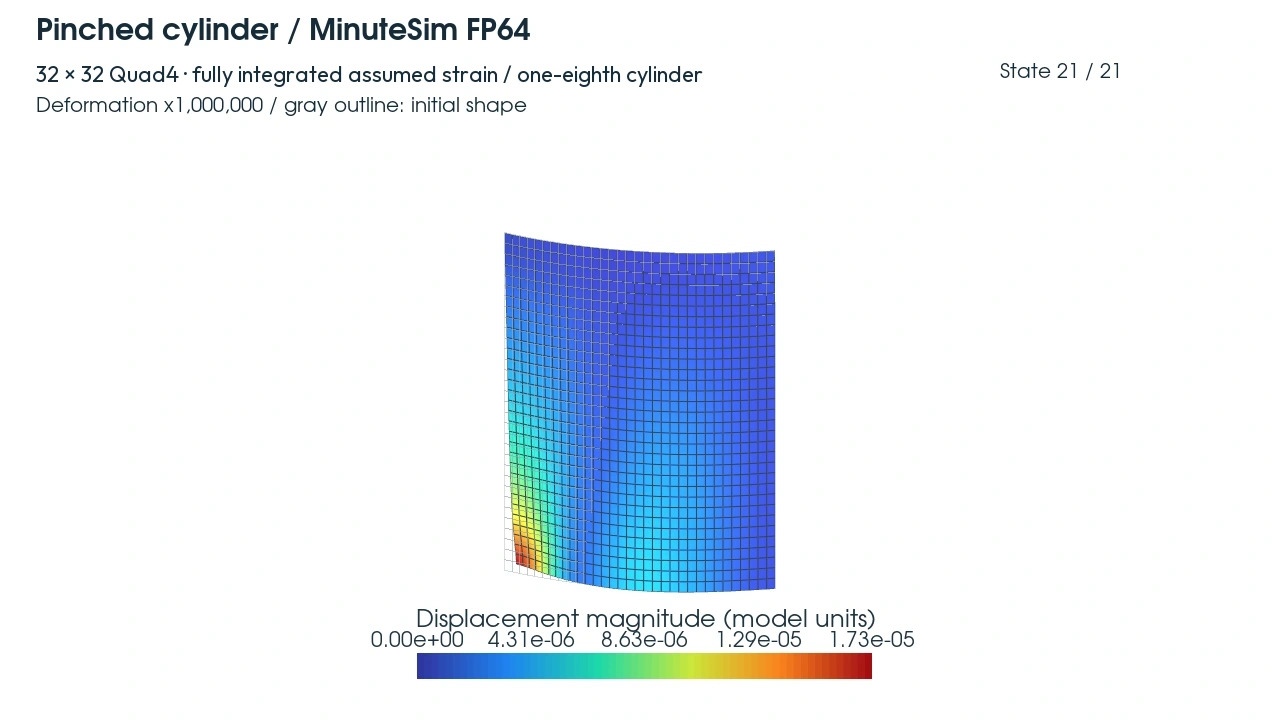
The 32 × 32 one-eighth mesh from the same FP64 result used in the table.
Full size ↗The saved loading and hold response, with deformation enlarged 1,000,000×.
Open video ↗Both views show the computed one-eighth region without symmetry duplication. Gray indicates the initial mesh. Deformation is enlarged 1,000,000×; the color legend retains actual, unscaled displacement magnitude |u| in model units.
The loaded-point displacement increases toward the conventional reference as the mesh is refined. The model uses an end-diaphragm boundary variant, so the differences include that modeling distinction.
Displacement under a pinching load.
Download plotted data ↓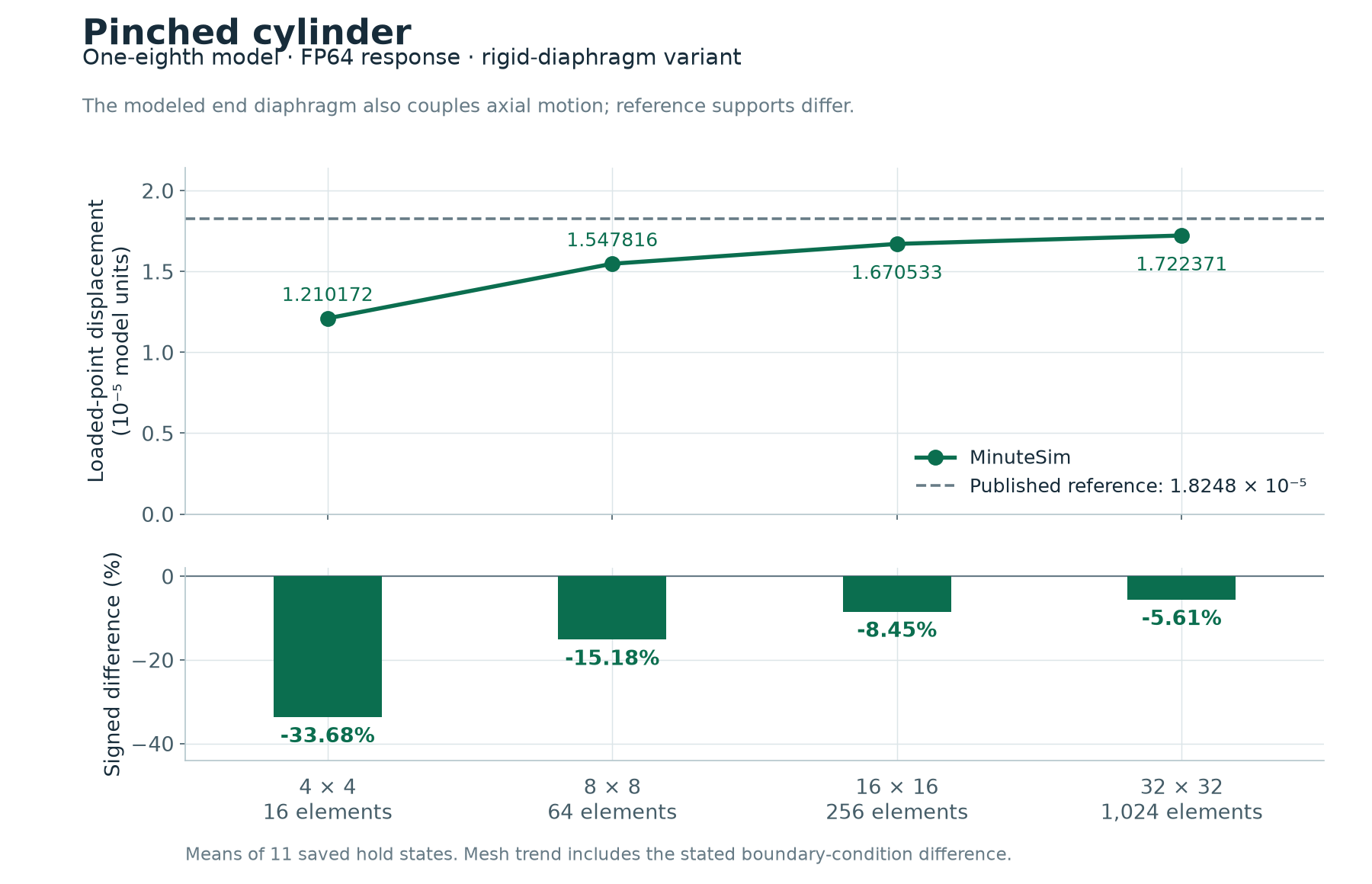
Mesh comparison
Boundary-condition difference: this model uses a rigid-body end diaphragm that couples axial motion as well as in-plane motion. The conventional reference uses a diaphragm that constrains only in-plane displacement. The table is therefore a comparison under a boundary-condition variant; it does not establish an error bound for an exact reproduction of the conventional benchmark.
The table reports the magnitude of the mean loaded-point x displacement over 11 saved states at model times 0.5–1.0. The conventional reference is 1.8248 × 10⁻⁵. Signed difference is 100 × (result / reference − 1).
Swipe sideways to read the full table →
| Eighth-model mesh | Elements | Nodes | Mean displacement (model units) | Signed difference |
|---|---|---|---|---|
| 4 × 4 | 16 | 25 | 1.2101721 × 10⁻⁵ | −33.68% |
| 8 × 8 | 64 | 81 | 1.5478157 × 10⁻⁵ | −15.18% |
| 16 × 16 | 256 | 289 | 1.6705326 × 10⁻⁵ | −8.45% |
| 32 × 32 | 1,024 | 1,089 | 1.7223705 × 10⁻⁵ | −5.61% |
These results use FP64 only. The response is smaller than a coordinate increment resolvable in the corresponding FP32 output, so FP32 is not used for this comparison. The contribution of the diaphragm difference has not been isolated.
Model and comparison conditions
Geometry and material
Cylinder radius: 300. Full length: 600. Thickness: 3. The consistent model-unit system uses E = 3 × 10⁶, ν = 0.30 and density 10−6. Quad4 · fully integrated assumed strain elements model one eighth of the cylinder, with the stated rigid-body diaphragm at the end.
Load and precision
A point load of −0.25 in x acts at (300, 0, 0), the modeled symmetry share of the conventional unit pinching load. It ramps after model time 0.001 to full load at 0.5 and is held to 1.0. These runs contain no global damping. All four results use FP64 on an NVIDIA GeForce RTX 4060.
Reference and scope
The Kratos pinched-cylinder benchmark documents the one-eighth model, opposing concentrated loads, conventional diaphragm condition and reference displacement of 1.8248 × 10⁻⁵.
This comparison documents one displacement component for four configured meshes. Its evidence class remains SUPPORTED because the diaphragm differs from the conventional reference. The result does not validate the local stress field, every shell capability or a universal 5.61% accuracy bound.
FP64 evaluation results: 8 October 2026. Values describe the supplied configurations and are not a claim about every released solver version.
SUPPORTED · Displacement comparison for the stated FP64 configurations with an end-diaphragm boundary variant. Evidence and comparison scope ↗