Translational damping / FP32 and FP64
Damped straight cantilever
A tip-loaded shell beam settles toward a static deflection with near-critical translational damping. Compare its single- and double-precision response histories and the static reference values.
Understand the analysis
A fixed root. A rising tip load.
The straight beam is clamped at its left end. An upward load at the free end rises to its full value over 2.5 ms, then stays constant until 7.5 ms. The model has six Quad4 · fully integrated assumed strain elements.
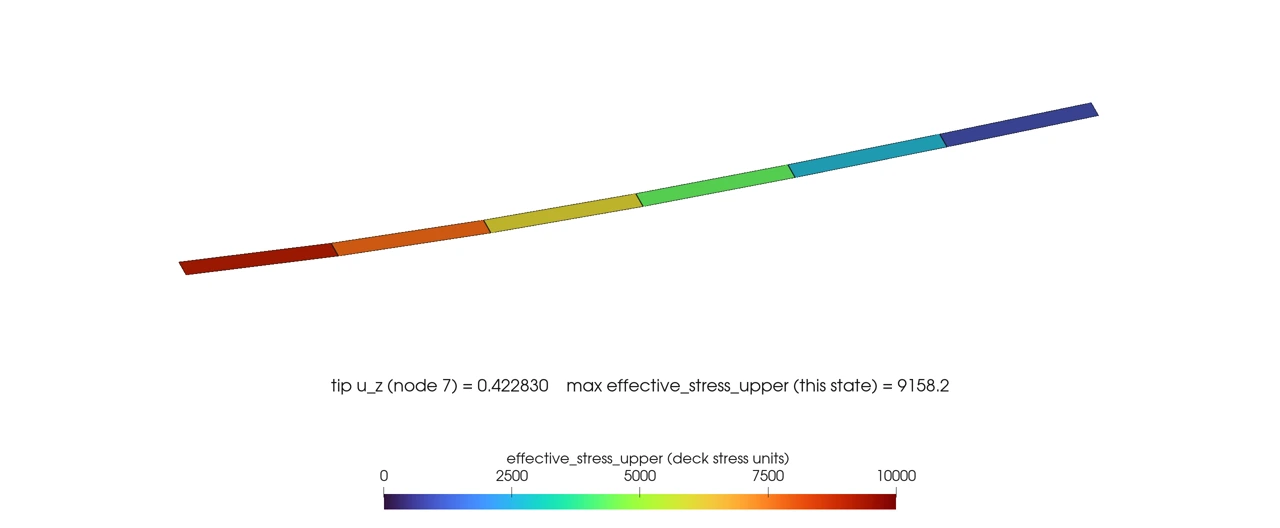
The actual computed shape at 7.5 ms, shown at true scale.
Full size ↗All 31 saved FP32 states, from the initially flat beam to the hold period.
Open video ↗Color shows shell-upper-surface effective (von Mises) stress in model stress units, on the original 0–10,000 scale. The maximum over the saved history is 9,162.5; the final-state maximum is 9,158.2. This field differs from the root axial stress σxx below. Shell midsurfaces are shown without thickness or displacement magnification; playback time is not simulation or solver time.
The two precision variants closely follow the same response. This comparison checks numerical consistency; agreement between precisions does not by itself establish agreement with an independent physical reference.
Displacement and stress through time.
Download plotted data ↓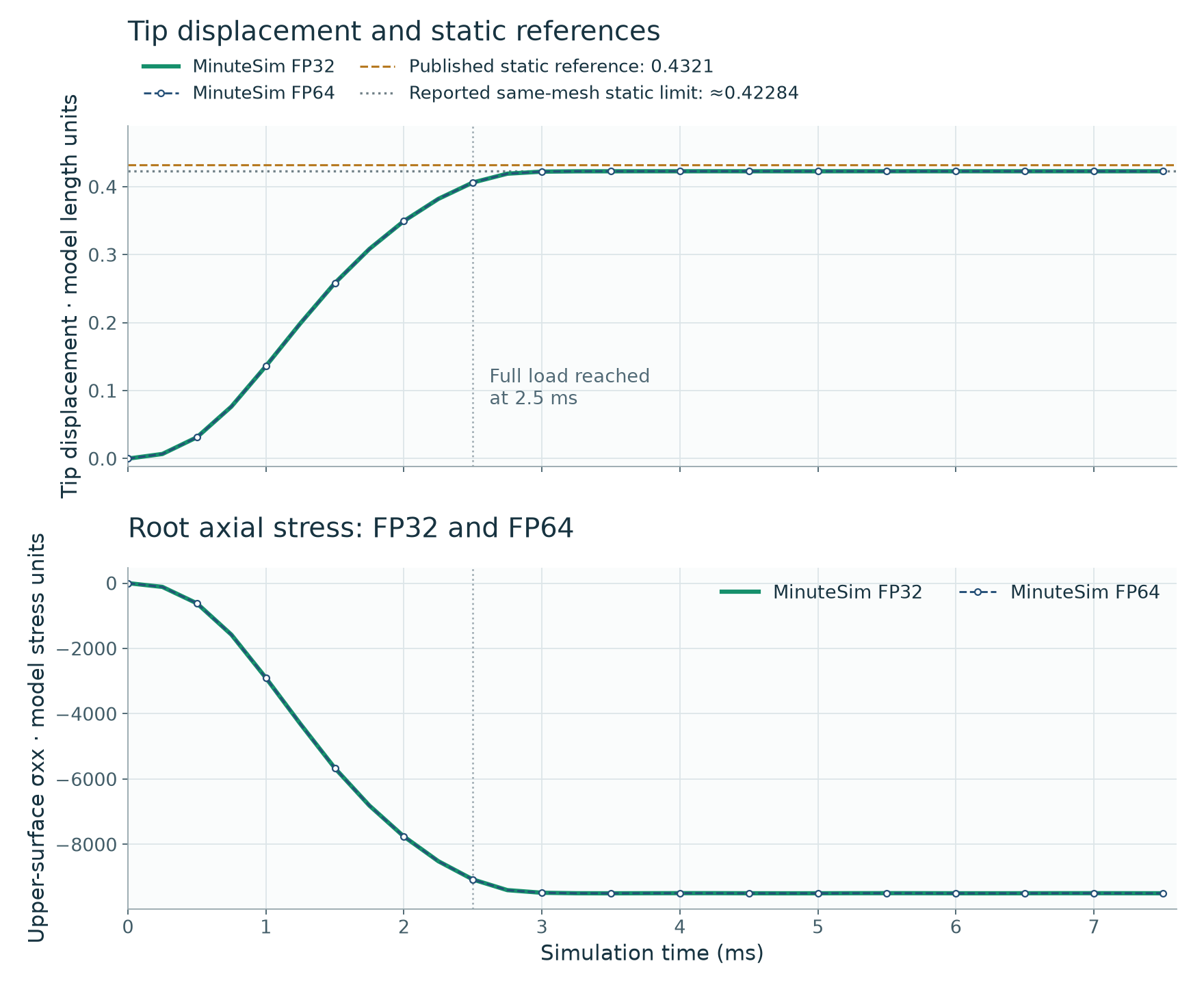
End-state results at 7.5 ms
| Quantity | FP32 | FP64 |
|---|---|---|
| Tip displacement (model length units) | 0.4228305 | 0.4228274 |
| Root upper-surface σxx (model stress units) | −9,496.381 | −9,496.377 |
| Total wall time (RTX 4060) | 14.1 s | 59.3 s |
Across the saved history, the largest absolute difference is 3.1754 × 10⁻⁶ for tip displacement and 0.022523 for root σxx. Values are paired by saved-state index; actual FP32 and FP64 times differ by less than 6.3 × 10⁻¹¹ s. The initial stress sample is the initialized zero state. The CSV retains all samples and both time columns.
Two different static comparisons
Same mesh, same solver
A separate longer FP64 run of this six-element model, with a different damping coefficient and ramp duration, approaches a tip displacement of approximately 0.42284. This rounded static-limit value is a same-solver consistency reference, not an independent analytical solution.
Published benchmark reference
The MacNeal–Harder straight-cantilever benchmark gives 0.4321 for the linear static tip displacement. The final values here are about 2.15% lower. This is one coarse six-element calculation; no mesh-convergence study is presented here, so the difference is not attributed solely to mesh size.
Model and comparison conditions
Length 6.0, width 0.2 and thickness 0.1; a 6 × 1 mesh of Quad4 · fully integrated assumed strain elements with 14 nodes. Linear-elastic material: E = 10⁷, ν = 0.30 and density = 10⁻⁶ in consistent model units. The input does not specify a physical unit system, so lengths and stresses are reported in model units.
Translations and rotations are fixed at the root. Total tip load is 1.0 in the +z direction, shared equally by the two end nodes. Translational mass-proportional damping is 17,800 s⁻¹ in all three directions; rotational damping is off. This is approximately critical for the first bending mode. The 2.5 ms ramp and 7.5 ms duration belong to this calculation, not to the original static benchmark.
MinuteSim FP32 and FP64 development results from 8 October 2026, on one NVIDIA GeForce RTX 4060. Both runs completed 138,161 time increments and wrote 31 states. Wall time includes setup and output, from process start until output files are closed. These timings describe this small case, not general solver throughput.
Scope and limitations
This case assesses translational damping with rotational damping disabled. Separate runs with rotational damping retained a slow increase in tip displacement and are excluded from the reported comparison. The present result does not establish rotational-damping accuracy.
The precision check and same-mesh static limit are self-consistency checks. The 0.4321 reference supports a separate linear-static displacement comparison; it does not supply an exact transient damped-response curve or independently validate the stress history. Differences between saved states are not covered by the 31-sample maximum values.
Reference
MacNeal and Harder, A proposed standard set of problems to test finite element accuracy (1985). The geometry and 0.4321 out-of-plane reference are also documented in NASA-CR-192816, Figure 2. The chart above is redrawn from the current MinuteSim run data; no source figure is reproduced.
SUPPORTED · Numerical comparison for this translationally damped configuration, with separate precision and static-reference checks. Broader scope is described on the Evidence page.