Solver A manual reference
Taylor bar impact
A cylinder impacts a rigid wall. The one-point tetrahedral and Hex8 examples are separate comparisons, with different hardening settings and reference entries.
Understand the analysis
A metal cylinder strikes a rigid wall.
The impact shortens the cylinder and spreads its contacting end into a mushroom shape. Length shortening, diameter growth and plastic strain provide three ways to compare the response.
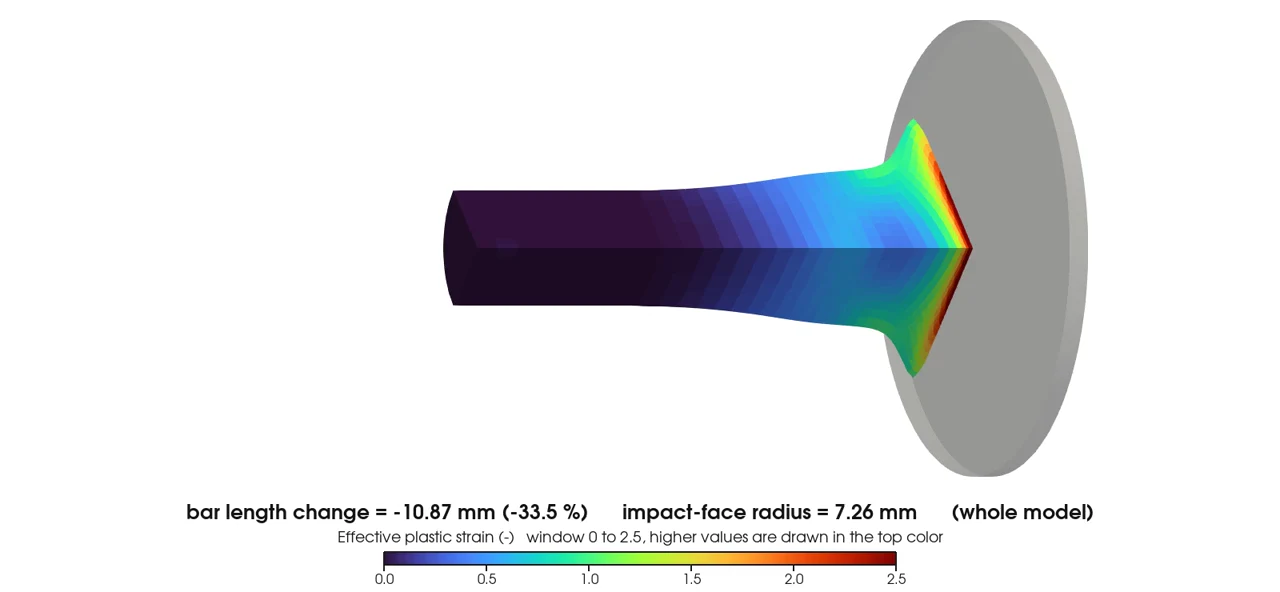
The deformed cylinder and its effective plastic strain field.
Full size ↗Impact, axial shortening and spreading at the wall.
Open video ↗Hex8 impact illustration from a separate output run; one quarter of the full model is shown. The visual illustrates the mechanism; the numerical table identifies the two comparison configurations.
The one-point Tet4 case differs by −0.46% in shortening, +4.05% in diameter growth and +0.07% in maximum plastic strain. The Hex8 result is compared with the manual’s fully integrated solid reference: −0.61%, −0.21% and +2.55%, respectively.
Impact response against a documented reference.
Download plotted data ↓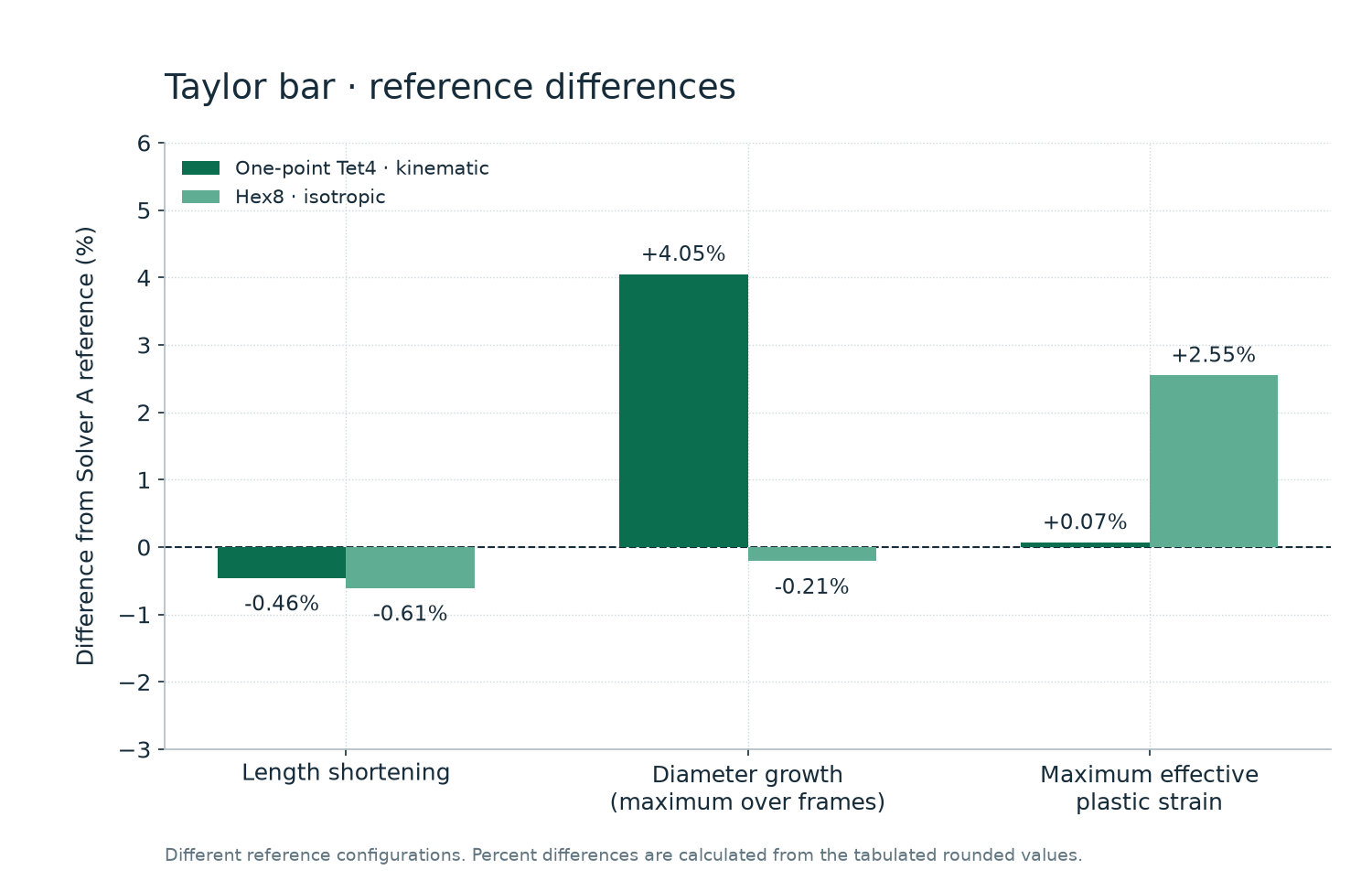
Read the physical quantities
| Quantity | Tet4 · MinuteSim | Tet4 · reference | Hex8 · MinuteSim | Hex8 · reference |
|---|---|---|---|---|
| Length shortening / mm | 10.993 | 11.044 | 10.869 | 10.936 |
| Diameter growth / mm | 7.493 | 7.201 | 8.122 | 8.139 |
| Maximum plastic strain | 3.059 | 3.057 | 3.452 | 3.366 |
Shortening and diameter growth are changes in length, not final specimen length or final diameter. The Hex8 comparison uses the manual’s fully integrated solid reference, including 10.936 mm shortening. It is not a comparison with a matched one-point Hex8 formulation.
Two separate reference comparisons
One-point Tet4
Kinematic hardening. The reported plastic-strain value is the integration-point maximum. The manual comparison corresponds to the one-point tetrahedral input configuration.
Hex8
Isotropic hardening. The reported plastic-strain value uses integration points at the committed end state. MinuteSim diameter growth is the maximum over recorded frames; the manual values are reported from its final contour output. The reference is the fully integrated solid entry in the manual. Different formulations and hardening settings make this a separate comparison.
Percent differences are recalculated from the rounded source values displayed in this table, so the last digit can differ from earlier summaries based on unrounded output. This chart does not rank the two configurations as a controlled element-only study.
Reference provenance
James M. Kennedy, LS-DYNA Introduction Examples Manual, June 2013 draft, Example 27 (Taylor Bar Impact), printed page 203 / PDF page 209. The one-point tetrahedral entry is ELFORM 10; the fully integrated solid reference is ELFORM 2. Solver A denotes LS-DYNA in this comparison. No manual page or figure is redistributed.
Run conditions: MinuteSim FP32 on an NVIDIA GeForce RTX 4060. Source results: 5–6 October 2026.
SUPPORTED · Numerical comparison record for the stated configuration. Broader validation and capability limits are described on the Evidence page.